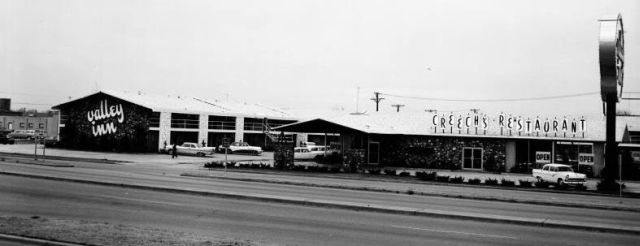
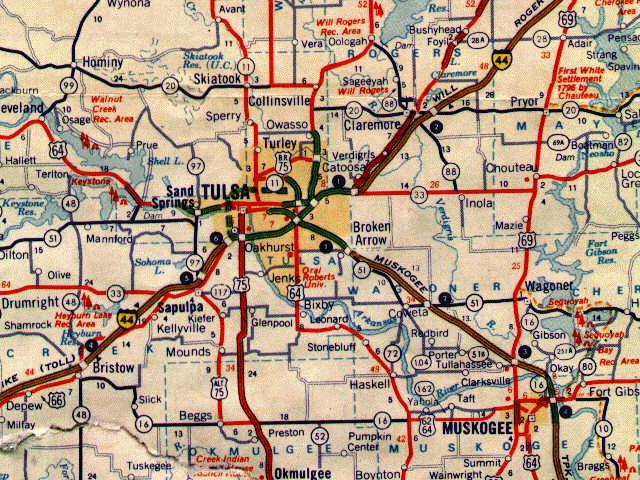
Topic: RIDESHY (circa 1974) When the characters R-I-D-E-S-H-Y were dialed on the telephone, you were indeed connected to one of Tulsa's most famous brothels. I think we found the number scrawled on a bathroom wall's For-A-Good-Time-Call section at a local Der Weinerschnitzel. Somehow after numerous prank calls, we managed to 'make an appointment' and were directed to a house behind and directly west of the old Camelot Inn. The house was just recently razed as part of the I-44 expansion project. As high school kids would, we launched the most heinous assault of taunting and outright vandalism that we could muster. After all, what were they going to do? Call the police? It started one night when John's mother gave us the remains of their Thanksgiving bone-in ham. Naturally, we took it to the residence and threw in through a window. Don't try this at home! We should've been shot! Another night we egged a baby blue Lincoln Continental parked there, only to be chased by the owner/driver from one end of the expressway to the other several times. We assume the Lincoln was low on gas; at least lower than John's mother's Blue Country Squire station wagon. Lucky for us. We continued to harangue these poor people for months, driving cars through the yard, throwing water balloons, eggs, biscuit dough from cans, and almost anything else at the front of this house. We even went to the door on Halloween wearing masks to get a closer look. No one came to the door, only a quickly pulled back curtain revealed a woman's face. As we were leaving a taxi drove up dispatching a customer clutching a brown paper bag containing a large bottle. This cemented our suspicion that the location was still entertaining guests. Finally, after months of harassment, a few close friends took up a collection one night and dared each other to take the funds and complete a real transaction at RIDESHY. Money rolled in more quickly than a volunteer to claim it, but eventually one of our own took the dare. After successfully making a 'reservation' over the phone, we were directed not to the residence we tormented, but to a motel just east of Peoria that still stands behind Waffle House.
As I.. er the volunteer climbed the stairs to the appropriate room number, he became filled with the terror of the 'what ifs'. What if she's hideous? What if I get busted? What will I tell my parents? What if I catch a horrible disease? He thought about turning and running away, but the gang was in the parking lot ready to ridicule any 'chicken', so he knocked anyway. There stood a scrumptious woman in her thirties with long hair and huge breasts. I.. er I mean HE walked inside the room sheepishly as the call girl quickly disrobed. "See anything you like?", she queried. What took place next I'll never forget. Although a brief encounter, it was also memorable. Exiting the room sans cash, I arrived at the car to a chorus of cheers. He did it! He did it! As we were leaving, that very woman walked out of the room and down to a parked car across the parking lot. It was only then we realized to our dismay that it was a Tulsa County Sheriff vehicle. She bent over and passed something to the occupant through the driver side window. We never called RIDESHY again!
My name is Joe Tanner. I'm currently working on an autobio and research led to your site. As an adolescent and the son of one of the highest earners there, I was employed at RIDESHY. I mowed the lawns of the various houses, tended bar at Bud Holt's private residence, etc. - flunky, gofer, call it what you will. I'm now 42 and trying to make sense of many things, not least of them being memories of the people and events at Rideshy and my time in Tulsa. My uncle was a local musician named Lynn Tanner. He played at Jose's Hideaway and the Filling Station, among other places. Any help you can offer wouild be greatly appreciated. Any persons with perspectives on the place and/or people, please contact me at rashlingo@yahoo.com. Thank you.
RIDESHY wasn't a place as much as it was a system. As indicated, it was the telephone number of a very big prostitution operation in the 1970s. The nonsensical moniker was easy to remember and didn't need to be written down or looked up in an address book. It was in the Riverside exchange (RI 3-ESHY) and therefore was portable, with an order through the phone company, from the Arkansas River east to maybe Lewis; close to Jenks to about 21st Street. It was the incoming Customer Service line. But no one ever went to RIDESHY, including most of the employees. If you were a regular customer, or referred by one, you called RIDESHY and left a message on a recorder. RIDESHY would call you back, unless they thought you were trouble, and take your "order". They then called to dispatch the appropriate Representative to come to you. Lots of "orders" came from hotels. Some of the Customer Service Representatives worked out of their own house or apartment. Once the service was arranged, the customer was directed to the employee's residence where the order was filled. So to speak. At times, RIDESHY rented apartments, typically in the Riverside area, but they could be anywhere. Customers, after calling the RI 3 number, would be directed to one of the organization's apartments. The only thing that actually existed at the RIDESHY telephone address were telephones, a dispatcher, and a manager. If the police took down one of the apartments, or an employee's home, all we got was a couple of Customer Service Reps and a couple of customers. The organization stayed intact and only a small piece of the business was impacted. Services were still be rendered elsewhere while the handful of suspects were being booked. They managed their risk very well. If the telephone location was raided, it was back up in business within hours and the same location or within a business day or two if they needed to move. Those people are all gone now, but I'd bet someone is doing the same thing with BlackBerries today.
I was reading through some of the RIDESHY info and thought I would relay what people in my age group had heard about this legendary "RIDESHY" service. Sometime around 1983-85, my group of friends had always heard of RIDESHY to get a hooker. We ranged from 5-7th grade, so it wasn't as if we could actually do anything, but we knew what it was, but had no idea how it worked. That didn't matter because we just prank-called the number. Over time, we realized the number was actually ringing to the pay phone of a bar somewhere in Tulsa, and it was inevitable that the later you called to prank the number, the more inebriated the person on the other end of the phone was. We were just being stupid kids, but sometimes, through our sophomoric cockiness on pretending to be a potential customer, we would get some MAJOR vulgarity to the drunkard on the other end of the line. We always thought it was hysterical. Sometimes they would lay the phone down for the long periods of time and you could hear lots of background noise, music and sounds that seemed to be pool tables. I can't ever recall that we were ever told the name or location of the bar, but for some reason I seem to think it was near I-44 and Peoria to just across the river on the west side off I-44. With that said, does anyone have any idea what that bar would have been? Obviously, RIDESHY was already dead and gone for almost a decade when we were calling. But the legend if it stayed alive at LEAST through the mid 80s, thanks to a bunch of adolescent pranksters.
Ah, the May Rooms, one of Tulsa’s finest. Shot one film story at the hotel which was a hop, skip and a “jump,” from KOTV. I remember a robbery one time at the “house of ill repute” and some of the “johns” were tied up when arrived. Many offered us money not to film them. We shot most of them of course, but edited out the faces, as a KOTV community service.
Strange, now that I think of it, that no one needed directions.
The address of Charlotte Bradford's Pearl Hotel in the 1945 telephone book was 17-1/2 East First, but I didn't go down to see if it's still there; I very much doubt it. There was no address for Pauline Lambert's May Rooms.... Pauline Lambert died, I think, about a decade ago and the local newspapers delved into history, but I would have no idea of the date, and this may not be what the public library normally keeps track of. Undoubtedly she appeared in stories by the late Tribune police reporter, Nolen Bulloch. I understand she appeared to be a genteel sort of lady away from the May Rooms. This didn't keep her out of court from time to time, of course.
(Referring to J.T.'s Rideshy note at the top of the page) The only part that rings a bell with me is Jose's Hideaway. I do know there was a high class call girl operation off Riverside Drive during the 70s. I have a mention of it in my still unpublished book (it is now published: How High Can a Guy Stoop?):
The girl's apartment was just off Riverside Drive. And she was gorgeous.
A small and inconspicuous blue-and-white sign positioned above the doorway at 326 1/2 E. First St. gave only a hint as to the true nature of the business transacted within. The May Rooms blended in with the rest of the commercial establishments up and down First Street, a strip that was known in the 1950s and '60s as Tulsa's Skid Row. There were flophouses and pawnshops and cafes that could only be classified as "greasy spoons." There also was a succession of bawdy houses -- houses of prostitution -- along First Street, just a few short blocks from the heart of Tulsa mercantilism. The May Rooms was Tulsa's best-known and longest-standing brothel, operating from the Great Depression through Urban Renewal under the exacting business standards of madam Pauline Lambert. Daughter of a Tennessee cotton farmer, Lambert opened the May Rooms in 1936 and continued uninterrupted until 1979. Tulsa judges referred to her as "a living legend" and "an unforgettable character." One judge said: "In the 1930s and '40s, coaches and alumni of winning high school football teams used to arrange for the team to go to the May Rooms." Lambert was ultimately forced by a Tulsa court to close the May Rooms in February 1979. She was 88 years old at the time. Tulsa's most renowned madam was convicted of pandering in 1978 and was facing three years in prison and a $1,000 fine. Her attorneys, however, continued to appeal the conviction while she was free on bond, and a judge delayed sentencing the wheelchair-bound Lambert. It was during this appeal process that the legend of Pauline Lambert was enriched and nurtured and grew to fabled proportions. She died on Oct. 31, 1979, in a Tulsa hospital of heart disease. The local obituary the next day carried the name of Clara Palmer, her maiden name. There was nothing to connect that name with the notorious bordello queen. Even her attorneys were unaware of her death. They continued to appeal her conviction -- for more than four years. PAULINE LAMBERT, APPELLANT, v. THE STATE OF OKLAHOMA In April 1980, an attorney filed a motion stating that Lambert had suffered enough by losing her home and business. A district court judge said he would indefinitely delay sentencing. In December 1983, the appeals ran out, and a Lambert attorney asked Presiding Judge Clifford Hopper to suspend her three-year prison sentence. Lambert's bondsman, ordered by the court to produce Lambert or forfeit the bond, spent several weeks tracking her, only to discover that she had been dead for more than four years. With that, Hopper closed Lambert's file by dismissing all charges against her. Thus, four years after her death, Pauline Lambert's career as Tulsa's mythical madam had come to an end. Upon learning of her death, a Lambert attorney said he was convinced that she had deliberately chosen to die in obscurity to protect her family's privacy. Jim Wilkerson was a taxi driver between 1946 and 1950 when Tulsa was going through the salad days of post-World War II. He met Pauline Lambert during those years, driving her many times between her home in Red Fork and "the place," her name for the May Rooms. "She was a very nice lady, really," Wilkerson said. "She could have passed for somebody's grandmother. "She wasn't a coarse person. I was amazed that that lady would be in that business." Apparently, Lambert abhorred smoking and drinking. She did not wear makeup. Once she threatened to sue a newspaper for writing that she had been arrested for public drunkenness. "I don't want to come off like some old gal run down like an alley cat," she said in a 1978 interview. Wilkerson said Lambert had led "two different lives." "She lived over in Red Fork and had a very fine family," he said. "She was a mother and a housekeeper and a well-thought-of person in that area. "But three or four days out of the week, she would come down to her place of business. She had a little two-room apartment back on the southeast corner. That was her place. I don't think Pauline was one of the working girls; she merely kept the cash register. "She was a frequent customer of the taxi company. And she was fairly generous. We'd go to Red Fork from downtown for 60 cents.She was always good for a buck, maybe buck-and-a-half. "She never was anyone to make a big high profile, and I guess in that kind of business, you don't want to." From two marriages, Lambert said she raised six children. In a 1978 newspaper interview, she said all of them had died. She said she helped to support a sister who had four children. The May Rooms was a walkup. Patrons walked up a flight of narrow stairs and entered into a lobby, or waiting room. The six or eight women who plied their trade there were perched on sofas scattered throughout an area that might measure 20 feet by 20 feet. Rooms were down a hallway. Those halls, Lambert said, were frequented by Tulsa's best and Tulsa's worst, by those who evaded the law and by those who enforced the law. "I'd say some of the founding fathers of our city grew up under her tutelage," said one Tulsa judge when informed of Pauline Lambert's death.
|



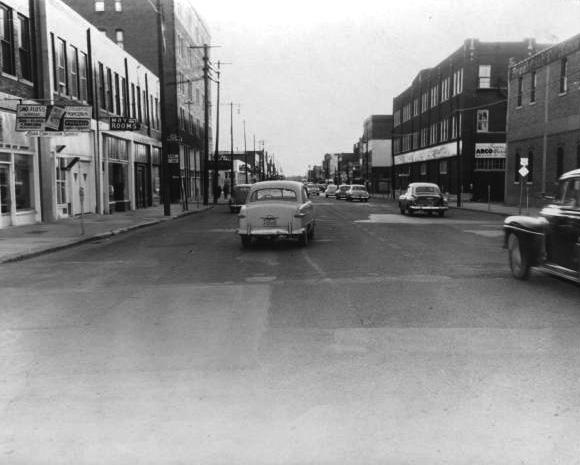
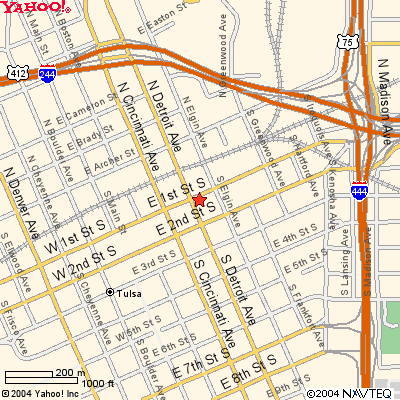 May Rooms (326 1/2
E. 1st St.)
May Rooms (326 1/2
E. 1st St.)